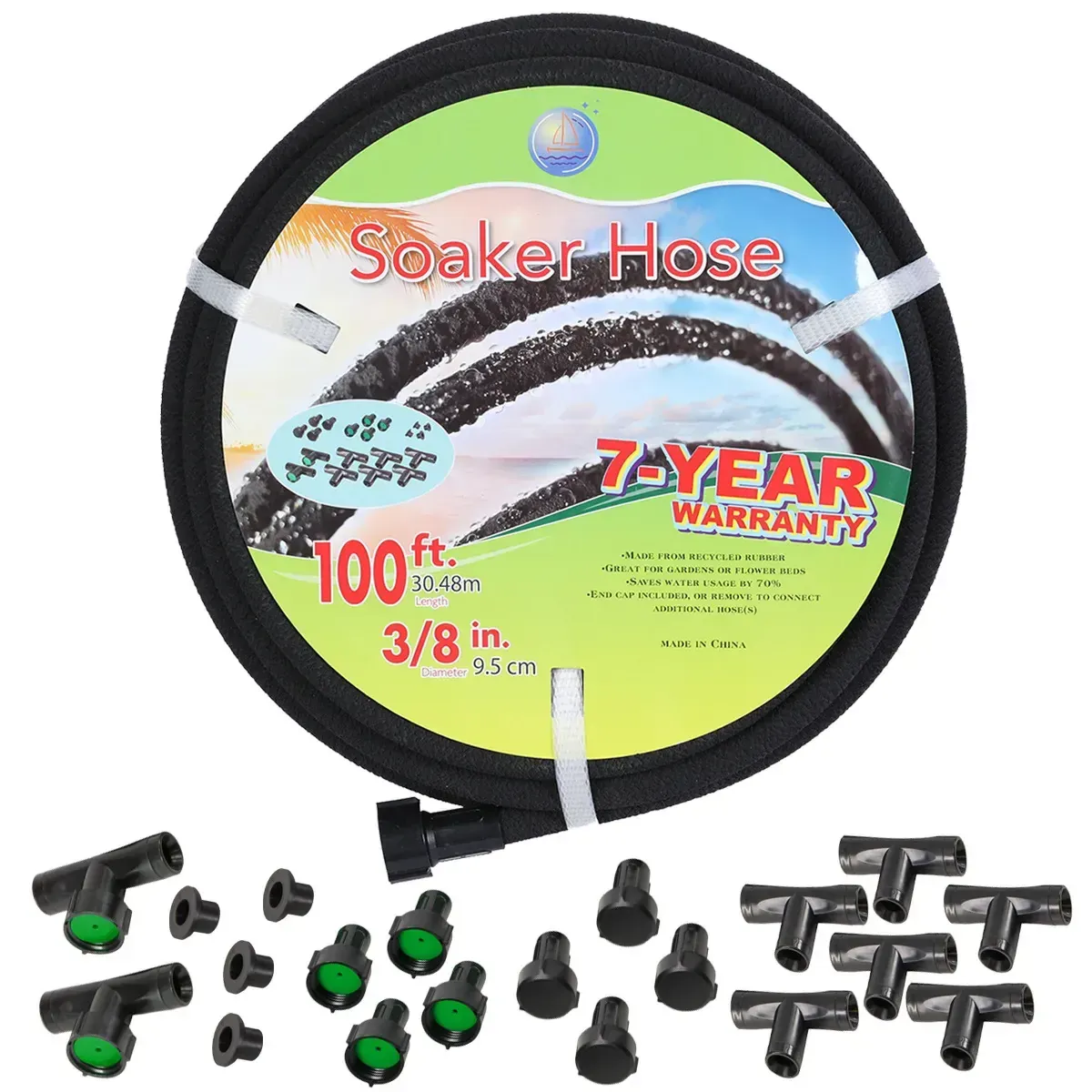

Porous pipe, leaky pipe, seep hose and soaker hose are the same product: a porous garden hose that leaks water slowly along its whole length at the root zone. The words change by market, which matters if you sell into the UK, Australia or other Commonwealth countries. This guide maps the terminology and covers the sizes, fittings and specs a wholesale buyer needs to get right.
Same product, different words
What a US buyer lists as a soaker hose is more often searched for as a porous pipe or leaky pipe in Britain, and as a weeping hose or soaker in Australia. If you sell in these markets, the name on your listing decides whether buyers find you at all. The common terms:
- Porous pipe and leaky pipe — the standard UK garden terms.
- Seep hose and seepage hose — used in the UK and by growers.
- Weeping hose — common in Australia and New Zealand.
- Soaker hose — the US and Canadian term, understood widely.
They all describe a hose that seeps rather than sprays. If you want the mechanics first, see what a soaker hose is, and for the choice against emitter systems, soaker hose vs drip irrigation.
How porous pipe works
The wall of the pipe is porous, so water pushed in at one end leaks out through fine pores along the full run instead of jetting from the far end. Laid along a bed, it wets the soil in a line right at the roots. Overhead watering loses a large share to wind and evaporation; porous pipe puts the water where it soaks in. The UK Royal Horticultural Society and water utilities both point gardeners toward this kind of root-level watering during hosepipe restrictions, and irrigation research summarized by the FAO supports it at scale. Used correctly on a suitable bed, a porous pipe run uses up to 70% less water than overhead sprinklers.
Where porous pipe suits UK and Australian gardens
It earns its place wherever plants run in a line or a block:
- Allotments and kitchen-garden rows
- Raised beds and borders
- Hedging and shrub lines
- Polytunnels and greenhouse beds, where a buried PE seepage hose gives controlled root-zone watering
- Vineyard and soft-fruit rows
During hosepipe bans and dry summers, porous pipe is one of the few watering methods that usually stays permitted, because it targets the root zone and wastes little. That seasonal pull is a real selling point for garden centres and online sellers.
Where it is not the right choice
Set expectations so the product does not come back:
- Spaced pots and individual plants are better served by drip emitters.
- Lawns want a sprinkler for even coverage.
- Very long single runs seep unevenly as pressure drops; split them into shorter lengths off a manifold.
- Any consumable-water use. Porous pipe is an irrigation product and is not rated for consumable water.
Sizes and fittings UK and AU buyers should confirm
This is where cross-market sourcing goes wrong if you skip it:
- Bore and outside diameter: the half-inch size, roughly 12 to 13 mm bore, is the standard garden porous pipe. Confirm the OD so it matches local connectors.
- Fittings and thread: UK and Australian taps and hose connectors differ from US ones. Confirm the product ships with, or accepts, the snap-fit or threaded connectors your market uses, so it works on a standard garden tap out of the box.
- Coil length in metres: quote and pack in metres, not feet, for these markets.
- Pressure regulator: mains pressure is often too high; a regulator keeps the pipe at its design pressure and prevents splitting.
Which specs shape the price
When you send an enquiry, the details that move a porous pipe quote are the diameter, the wall thickness and material grade, the coil length and pricing unit (per metre, per coil or per case), whether a regulator or filter is included, and the packaging. Decide these before you ask, and confirm working pressure, burst pressure and any certifications against your actual order rather than a marketing page. A supplier that invents those numbers is a bigger risk than one that marks them contact for spec and confirms them per order.
Sourcing porous pipe wholesale
Run a small trial order before container volume: a low MOQ, a written lead time, and a sample you can put through a season. For private label, custom coil length, local-language packaging and your own brand are standard, so you can list porous pipe under the term your market searches for, with the right fittings and a defensible margin. If you import directly, freight and lead time matter as much as unit price.
What pitta supplies
pitta is a US-registered soaker and porous pipe brand supplied factory-direct from an established Qingdao manufacturing partner. The range covers 3/8 to 5/8 inch in durable PE-rubber, foamed-rubber and reinforced builds, plus a seepage hose for greenhouse beds. Tell us your market, target sizes and the fittings you need, and we will spec it for local taps. It ships at low, trial-friendly MOQ and is private-label ready. See the full range.
Selling porous pipe or leaky pipe into the UK or Australia? Send your target sizes, coil lengths and fittings and we will come back with specs, MOQ and lead time. Request a wholesale quote, or ask about sample availability so you can test a coil on a local tap before you scale.